
RouteMind AI fleet dispatch case study
AI Fleet Advisor + live load board
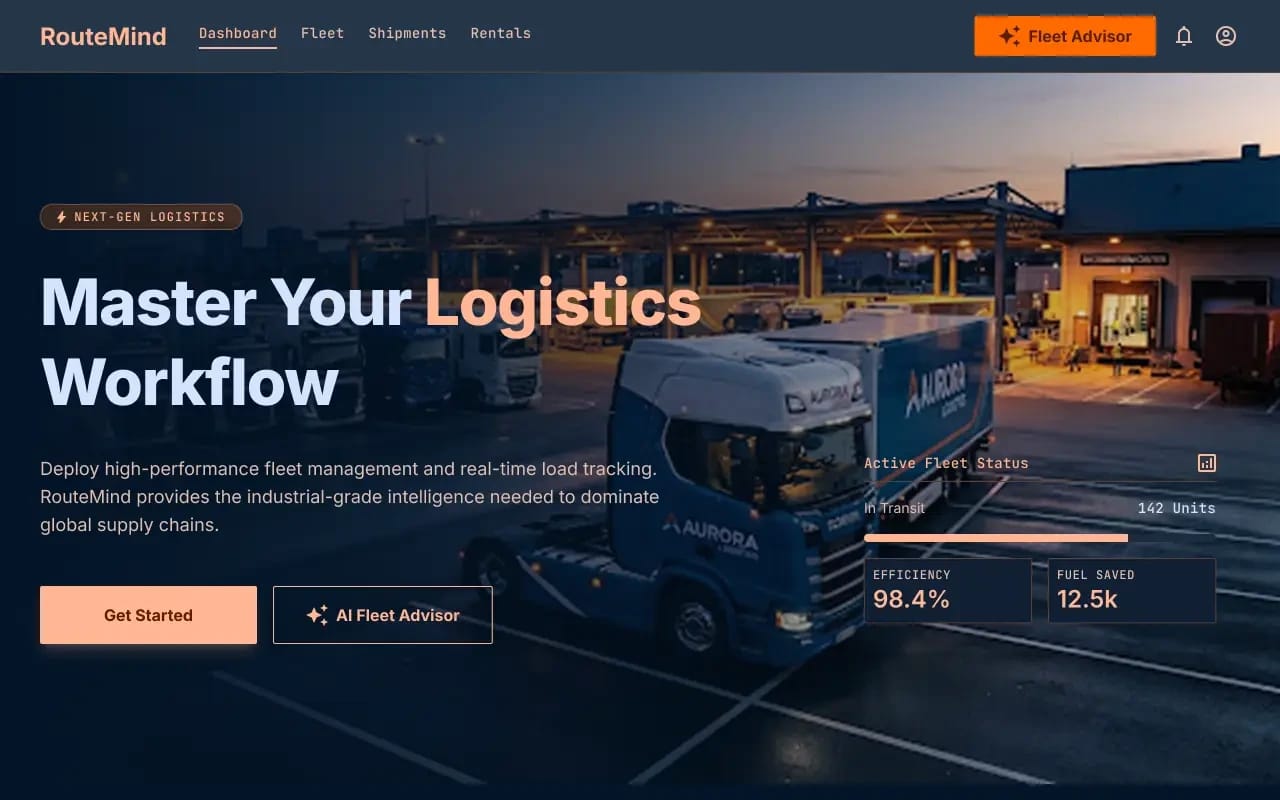
RouteMind is an AI fleet dispatch platform with a live shipper load board and an AI Fleet Advisor. Dispatch teams match freight to capacity, plan routes with Google Maps inside the product, and keep vehicle status on one dashboard instead of scattered tools.
Project intent
RouteMind is fleet and logistics software for shippers and carriers who still assemble the day from spreadsheets, radio, and half-stale boards. Dispatch should cost less time and fewer empty miles. The product pairs a live load board with an AI Fleet Advisor. Planners match freight to available trucks and compare paths with Google Maps data inside the same UI instead of gut feel in a side tab.
Empty miles and stale boards were the business pain. When capacity is a guess, trucks deadhead and fuel burns for no revenue. Status, distance, and advisor guidance had to show up where dispatchers already work. Another spreadsheet export at the end of the shift was not going to cut it.
Dispatchers needed advice that respected current capacity, not a generic logistics chatbot. The Fleet Advisor had to read live loads and vehicle state, then suggest moves a planner could accept or reject in the same screen. RouteMind was never meant to replace judgment. It was meant to cut the time spent assembling the picture before judgment starts.
Challenge
Dispatchers juggled spreadsheets, radio, and half a dozen tools. Capacity was a guess. Load boards went stale by lunch. Route choices burned fuel because nobody could see which path actually paid after distance, time, and vehicle status shared one screen.
Proof-of-delivery files and route logs lived elsewhere, so disputes meant digging through email. Map tools sat outside the ops UI, so geocoding and distance checks were manual. The team needed a single fleet dashboard, a shipper-facing board that stayed current, and advisor prompts that used live operations data instead of generic logistics tips.
Multi-stop planning made the gap worse. A route that looked fine on a whiteboard fell apart once distance matrix numbers and real vehicle status entered the picture. Without Google Maps inside the product, planners bounced between tabs and mistyped addresses. Without a shared data model, the shipper board and the fleet dashboard drifted apart by afternoon.
Leadership wanted fewer tools, not another login. Any new board had to replace spreadsheet rituals instead of sitting beside them. That pushed us toward one ops model for loads, capacity, and routes, with Maps and advisor calls as features of that model rather than side products.
Solution
We built RouteMind on React and Tailwind with an Express API on AWS. RDS PostgreSQL holds operations data. Amazon S3 stores proof-of-delivery files and route logs. Google Maps handles routing, geocoding, and distance matrix calls inside the product. The UI deploys on Vercel. Backends run on EC2 and Elastic Beanstalk with Sentry and CloudWatch for monitoring.
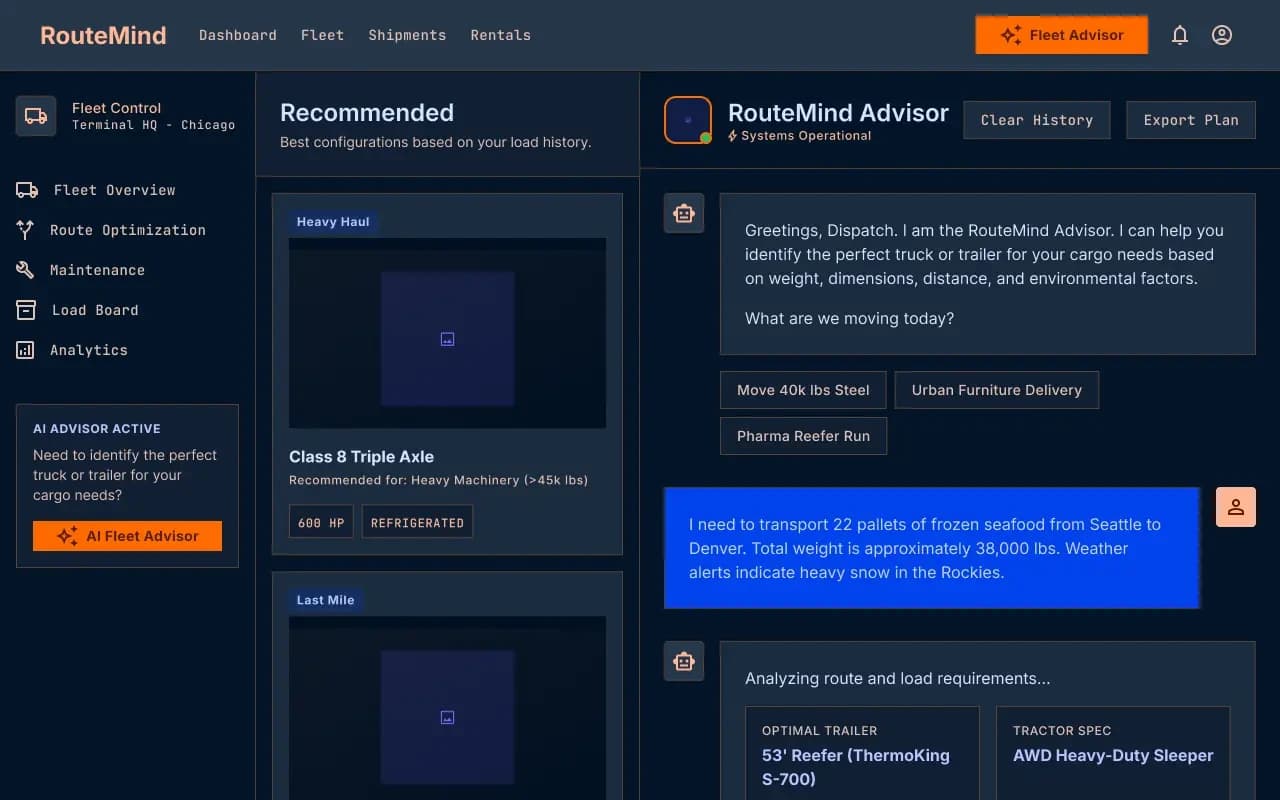
The AI Fleet Advisor sits on that stack. It reads load, vehicle, and route context from the API, then suggests dispatch and routing moves the planner can accept or ignore. The shipper load board and fleet dashboard share the same data model so capacity and freight stay in sync during the day.
We treated the advisor as a product feature on top of ops data, not a chat widget bolted on later. Recommendations show up where dispatch already works. Accepting a suggestion updates the same load and vehicle records the board uses. AI output stays accountable to the same PostgreSQL truth as manual assignments.
Proof-of-delivery storage on S3 closed a common dispute gap. Dispatch could attach delivery evidence to the same load record used for planning. Sentry and CloudWatch covered the dull but necessary part: knowing when an API host or Maps dependency started failing during peak hours.
Architecture
React clients on Vercel call an Express API hosted on EC2 and Elastic Beanstalk. PostgreSQL on RDS is the source of truth for loads, vehicles, assignments, and advisor session history. When a planner opens a route, the API asks Google Maps for geocoding, routing, and distance matrix values, then stores the planning snapshot with the load.
Proof-of-delivery uploads and route logs go to Amazon S3 with references kept in Postgres. The Fleet Advisor path loads current capacity and open freight, calls the model with that structured context, and returns recommendations into the same dashboard. Sentry tracks client and API errors. CloudWatch watches host metrics so a slow Maps call or a saturated Beanstalk environment shows up before dispatch queues stall.
Express routes gate Maps calls and advisor prompts so quotas and timeouts stay visible. Elastic Beanstalk and EC2 hosts scale with dispatch peaks. Vercel ships UI changes without waiting on API deploys. Frontend iteration stays fast while the Node layer owns the logistics rules that cannot afford a casual rewrite.
Planning snapshots stored with each load make it possible to revisit why a route was chosen without reconstructing the day from memory. That audit trail matters when shippers and carriers argue about miles, windows, or capacity that looked different at assign time.
Security and access
Ops data for loads, vehicles, and assignments lives in PostgreSQL on RDS and is served through the Express API, so access follows that API rather than shared spreadsheets. Proof-of-delivery files sit in Amazon S3 with load links in Postgres, which keeps delivery evidence tied to the right record.
Google Maps API keys stay on the server path for geocoding, routing, and distance matrix calls. Sentry and CloudWatch watch client and API errors plus host metrics so a bad Maps dependency or saturated Beanstalk host shows up during peak dispatch hours.
Key features
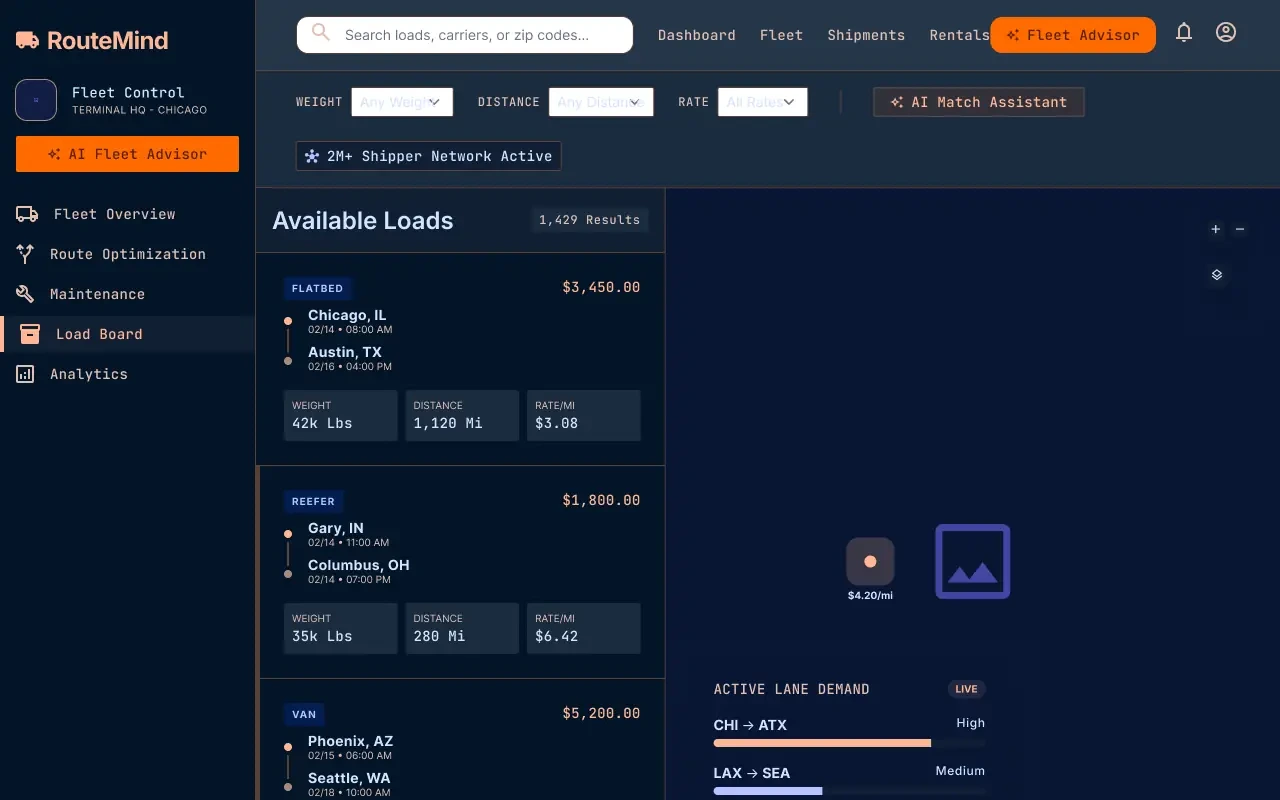
- Live shipper load board for freight and capacity
- AI Fleet Advisor grounded in current ops data
- Google Maps routing, geocoding, and distance planning in product
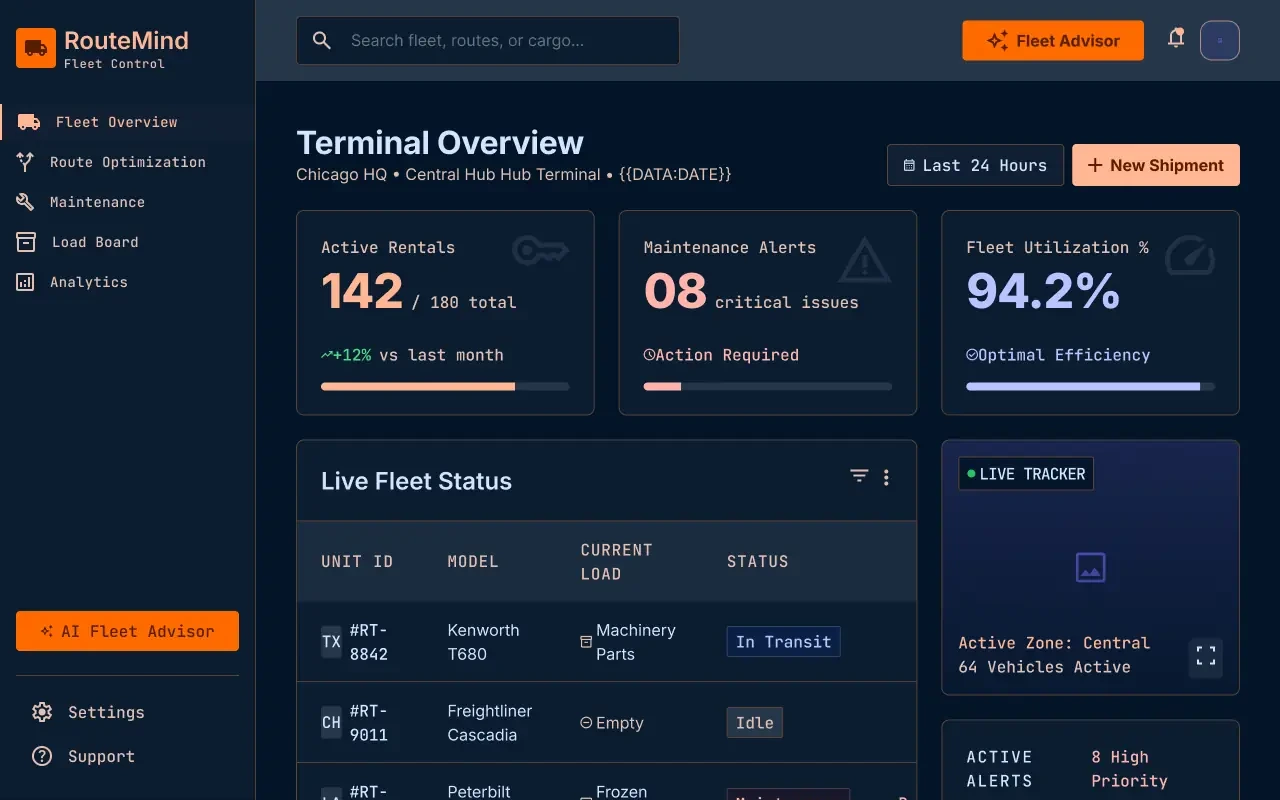
- Fleet dashboard for vehicle status across the day
- Proof-of-delivery and route log storage on Amazon S3
- Sentry and CloudWatch monitoring on AWS-hosted APIs
Results
- Live shipper load board for capacity and availability
- AI Fleet Advisor that guides dispatch and route choices
- Google Maps routing, geocoding, and distance planning in product
- Fleet dashboard for vehicle status across the day
Product screens
Technology stack
Related services
- AI & Data InnovationGenerative AI, ML, and data pipelines that land in products people use, not pilots that die on a slide deck.
- Custom Software DevelopmentFrom discovery through production releases, we build the systems your business actually runs on.
- Cloud & DevOpsAWS, Azure, or GCP with CI/CD and automation so releases stay boring in the good way.
Frequently asked questions
Want to talk through a similar build? Contact Algo Vortex or browse the full FAQ.